Case study — product evidence in practice

We ran our own product through the library.

CopyCat is our desktop app — a 10-slot clipboard with on-device dictation, screenshots and local AI. Every claim on its page had to survive the same grading we apply to everyone else’s. This is the receipt.

See the live page Skip to the pricing breakdown

The product

One app, in place of three subscriptions.

CopyCat replaces the screenshot tool, the dictation tool and the AI clipboard — for one payment of $49.99, running entirely on your machine. No account, no cloud, no renewal. That position isn’t a slogan; it is the entire pricing argument, and the page had to prove it.

10-slot clipboard

Copy into numbered slots; paste from any of them, in any app.

Local AI transforms

A prompt per slot — summarize, translate, rewrite — on-device, no API keys.

On-device dictation

Hold a key, talk, release. Recognition never leaves the laptop.

Screenshot capture

Grab a region straight into a pinned, editable window.

The breakdown

Two versions of one pricing section.

Recreated from the shipped pages so you can see what changed at a glance. The second is live right now. Every decision inside them is pulled apart below — one exhibit, one number, one instruction each.

Version 1 the first shipped pricing section (recreated)
One price. Yours forever.

Replace three separate tools—and three recurring bills.

Screenshots
CleanShot X
up to $120/yr
Dictation
Wispr Flow
$155.88/yr
AI clipboard
Raycast AI
$120–$240/yr

Comparable tools can cost $395.88–$515.88 every year

Best value
$49.99 one time
Lifetime access. Updates included.
SAVE $345+ IN YEAR ONE
Buy for Mac Buy for Windows
  • 10-slot clipboard + custom shortcuts
  • Local AI transforms
  • On-device voice dictation
  • Screenshot capture + editing
  • Lifetime updates included

No subscription. No account. No seat count.

Version 2 live now (recreated)
Buy it once. Save every year.

One CopyCat license replaces recurring screenshot, dictation, and AI clipboard subscriptions.

Lifetime deal
$49.99
one payment · yours forever
Get CopyCat for Life
For macOS · Apple Silicon & Intel
  • 10-slot clipboard
  • AI transforms
  • Voice dictation
  • Screenshot capture + editing
  • All future updates
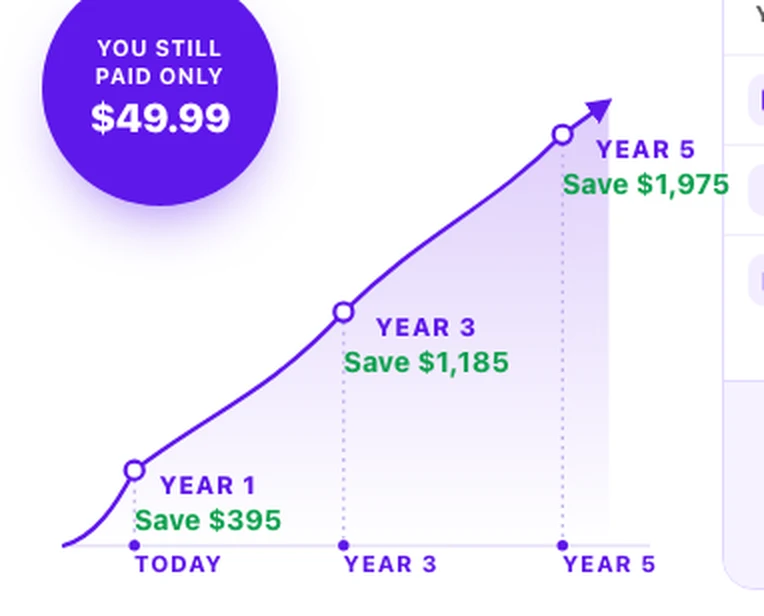
Your savings keep growing
Year 1 · $395 Year 3 · $1,185 Year 5 · $1,975 YOU STILL PAID ONLY $49.99
Yearly cost of 3 tools
Screenshots $120/yr
Dictation $155/yr
AI clipboard $120/yr
$395EVERY YEAR

The longer you use it, the more absurdly valuable it becomes.

3 separate subscriptions 1 app 1 payment

No subscription. No account. No surprise renewal.

The decisions, graded

Eight decisions. One exhibit, one number, one instruction each.

Each card shows the actual thing that shipped, the single number that justifies it, and what to copy. Open the sources drawer only if you want the paper trail — including the two claims we blacklist outright.

01

Anchor with the real bill, before your price

SOLIDCONTESTED
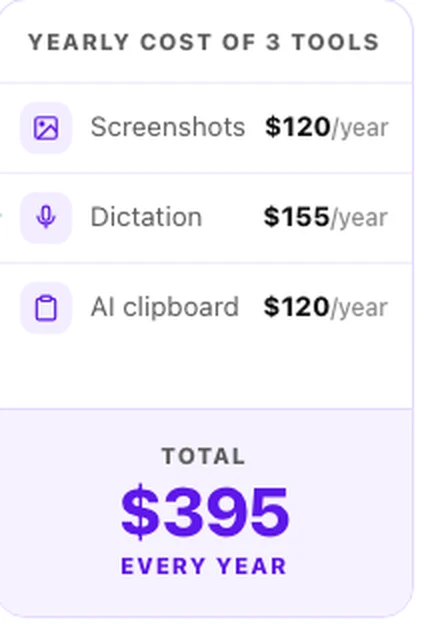
CopyCat's cost table listing three competing subscriptions totalling $395 every year
The competing tools’ real list prices, shown before CopyCat’s price appears anywhere on screen.
4 of the top 5

Anchoring took four of the five largest effects in psychology’s biggest replication project — 36 samples, 6,344 people. It is about as reliable as this field gets.

Their bill$395/yr
CopyCat$49.99
Do thisAnchor against a bill your buyer already pays, with named products and checkable prices. Invented “was” prices are a different, worse tactic.
Sources & the honest limits (3)

Klein et al. (2014), Many Labs 1, Social Psychology 45. 36 samples, N=6,344. Anchoring produced four of the five biggest effect sizes in the whole project, and replications came out larger than the originals. SOLID.

Urbany, Bearden & Weilbaker (1988), JCR 15(1). Advertised reference prices raise perceived value — the peer-reviewed basis for strikethrough pricing. SOLID for direction.

The limit we will not paper over. Those anchoring effects are on factual estimates, not prices. Anchoring willingness-to-pay is real but probably a half to a third of the famous demo’s size — CONTESTED. And in our own audit only 7 of 60 pricing pages use a strikethrough anchor at all, so this is a minority pattern, not a default.
02

Sell the absence of a meter, not the price

SOLID
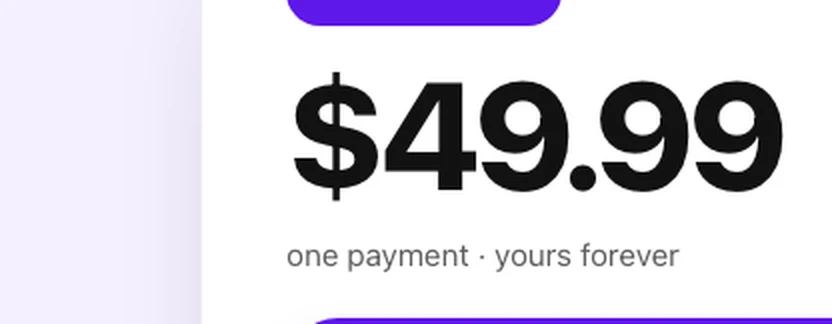
The CopyCat price block reading $49.99, one payment, yours forever
“One payment · yours forever” sits directly under the number — the headline promise is the billing model, not the amount.
48%

of 10,882 real broadband customers chose a flat rate even though metered billing was cheaper for them. Only 8.5% erred the other way — and it did not raise churn.

Flat-rate48.1%
Per-use8.5%
Do thisLead with what the buyer stops having to manage. A lifetime licence is the flattest rate there is; say that before you say the number.
Source & what it really shows (1)

Lambrecht & Skiera (2006), JMR 43(2). 10,882 DSL customers. 48.1% exhibited flat-rate bias versus 8.5% pay-per-use bias; over half the flat-rate group knowingly paid double or more than their cheapest available tariff. Crucially it did not increase churn — pay-per-use bias did. SOLID.

The finding is not “people are bad at maths.” They are buying insurance against the taxi-meter feeling, and they stay longer for it.

03

Aggregate their cost. Keep yours a single number.

SOLIDUNTESTED
The savings chart showing $395 saved by year one rising to $1,975 by year five while the price stays $49.99
Their cost compounds across five years; the $49.99 sits frozen in the bubble beside it. Same trick as “pennies a day”, pointed the other way.

enrollment when an identical deposit was framed as “$5 a day” instead of “$150 a month” — in a real fintech field test. Framing the period changes what the number gets compared to.

Year 1$395
Year 3$1,185
Year 5$1,975
Do thisAggregate the cost you want to look large. Keep the cost you want to look small in the smallest honest unit — and never let the two share a unit.
Sources & the part that is our guess (3)

Hershfield, Shu & Benartzi (2020), Marketing Science 39(6). Field test in a savings app: “$5/day” versus “$150/month” roughly quadrupled enrollment (~30% vs ~7%), and the daily frame erased the gap between lowest- and highest-income users. SOLID.

Gourville (1998), JCR 24(4). “85 cents per day” drew 52% agreement against 30% for “$300 per year” — for more total money. Per-period framing retrieves trivial comparisons; aggregate framing retrieves big ones. SOLID. Boundary: it backfires once the daily figure stops being trivial.

Our extrapolation, labelled. Every one of those studies frames the price. We invert it to frame the competitor’s cost. The mechanism is the same and we think the inference is sound, but no direct test of a savings-over-time chart exists. UNTESTED — believe the mechanism, not a number.

04

One action at the moment of decision

NO GRADE
A single purchase button reading Get CopyCat for Life
Version 1 had two purchase buttons and a badge competing for the same glance. Version 2 has one.
0 controlled tests

exist in our library comparing one call to action against two on a lifetime-purchase card. So this card gets no grade — and we are not going to borrow one from someone who is guessing.

Do thisMake the focused choice if you like it — but file it as taste, not evidence. Anyone selling you a number for this is selling you folklore.
Why this is deliberately ungraded (1)

The adjacent research on reducing choice lives in our decision-fatigue brief, and our pricing audit shows the market convention is a single visually privileged action. Neither is a test of this decision.

Part of the change is simply scope: the live page currently sells macOS only, so the Windows button had nothing to point at. An evidence page should say that plainly rather than dress a roadmap fact up as psychology.

NO GRADE. Practitioner judgement, declared.

05

The 9-ending we kept — and would drop for a luxury product

SOLIDCONTESTED
The price rendered as $49.99
The most famous device on any pricing page — and the one our own brief grades hardest.
22 of 55

pricing pages in our audit use any 9-ending headline price. Half the market prices round. This is a convention, not a law.

9-ending22/55
Round27/55
Do thisUse a 9-ending when you are selling a deal. Round it when you are selling a feeling — the evidence flips by category, not by preference.
Sources, including the one that found nothing (4)

Thomas & Morwitz (2005), JCR 32(1). The mechanism is real and narrow: $2.99 is perceived as meaningfully smaller than $3.00, while $3.59 versus $3.60 does nothing — the left digit has to change. SOLID.

Anderson & Simester (2003), QME 1(1). Three real catalogue field experiments: $9 endings raised demand, including demand rising when a dress went from $34 to $39. SOLID — but the authors frame it as a “this is a deal” information cue, strongest when buyers lack other price information.

Wadhwa & Zhang (2015), JCR 41(5). Rounded prices evaluate better for hedonic purchases — champagne at $40.00 beat $39.72. Round signals quality; that is why luxury prices are round.

Escher et al. (2026), Frontiers, N=729, preregistered. $9.99 versus $10.00: no reliable effect on purchase intention. CONTESTED as applied to conversion — keep the mechanism, drop the certainty.

06

Put the whole number first, and say so at the end

SOLID
Fine print reading: No subscription. No account. No surprise renewal.
The close of the section: three subscriptions collapse to one payment, then the last line names the three specific surprises that are not coming.
45%

more likely to abandon — that is what happened at the exact checkout step where hidden fees appeared, in a randomised experiment across several million users.

Revenue+21%
Bail at fees+45%
Do thisShow the full price at first contact. If a cost appears later than the first number, you are buying revenue with abandonment and, increasingly, regulatory risk.
The strongest field evidence in the whole space (2)

Blake, Moshary, Sweeney & Tadelis (2021), Marketing Science 40(4). StubHub, several million desktop users, randomised roughly 50/50. Showing base prices and revealing ~15% fees only at checkout raised spend +20.6% — while making those users ~45% more likely to abandon at the step where the fee appeared. SOLID.

Read it the right way round. This is simultaneously the best proof that hiding costs “works” on revenue and the reason it is now illegal in several categories — the FTC’s Junk Fees Rule took effect 12 May 2025. CopyCat runs the inverse: the first number you see is the only number.

07

Name the exact fear, at the exact moment

SOLIDCONTESTEDBLACKLISTED
The hero call to action with the line: 0 bytes uploaded, no cloud, no account, no subscription
Directly beneath the button: “0 bytes uploaded — no cloud, no account, no subscription.” Three named fears, not one general promise.
55%

of all 3-day-trial cancellations happen on day zero — people starting a trial and immediately killing it so it can never charge them. Buyers now treat billing as adversarial.

They guess$86/mo
They spend$219/mo
Do thisName the specific thing being feared, in the buyer’s words, within a glance of the button. “Trusted” and “secure” answer nothing.
Four sources — one of which we blacklist (4)

RevenueCat (2026), telemetry across 115k apps. 55% of 3-day-trial cancellations occur on day zero. SOLID as telemetry.

Tsai, Egelman, Cranor & Acquisti (2011), Information Systems Research 22(2). Put compact privacy information into a shopping interface and people bought from more privacy-protective retailers, paying roughly 59 cents more for identical batteries. Privacy shifts real money — but only when it is visible at the decision. SOLID.

The counterweight: John, Acquisti & Loewenstein (2011), JCR 37(5). Disclosure responds to cues that bear little — sometimes inverse — relation to real risk, and activating privacy concern up front dampens the effect. Shouting about privacy can leave people more guarded, not less.

BLACKLISTED: “trust seals lift conversion 11.5%.” A misattribution to Baymard, who publish preference surveys, not lift experiments. No credible independent measurement of badge lift exists. The bet here is that a checkable fact — “0 bytes uploaded” is true or it is not — behaves differently from a badge. Vendor-reported hesitation research (Blinkist) is CONTESTED: credible, no methodology published.

08

The button names what you get, never what you pay

SOLIDUNTESTEDBLACKLISTED
The hero button reading Get CopyCat, $49.99
Every purchase control says “Get CopyCat”. None of them says “Buy” — while the price stays visible on the button itself.
insula

The brain region that anticipates pain and loss lights up at an excessive price — and that signal predicts whether someone buys, better than what they say about themselves.

+90%“First-person CTAs” — one A/B test, no n published
+14.79%“Get beats Order” — same practitioner, same problem
Do thisPoint the label at the outcome, keep the price on the button. Costs nothing, hides nothing — and ignore anyone quoting you a percentage for it.
The mechanism, and the numbers we refuse (4)

Knutson, Rick, Wimmer, Prelec & Loewenstein (2007), Neuron 53(1). During real purchase decisions, product preference activated the nucleus accumbens while excessive price activated the insula — a region tied to anticipating pain and loss. Each predicted the actual purchase beyond self-report. SOLID.

Prelec & Loewenstein (1998), Marketing Science 17(1). The pain-of-paying model: a purchase is a contest between the immediate pleasure of acquiring and the immediate pain of paying. SOLID as theory.

Thaler (1985), Marketing Science 4(3). Acquisition utility (what the thing is worth to you) versus transaction utility (how the deal feels). Get points at the first; Buy points at the second.

BLACKLISTED. “First-person CTAs lift clicks 90%” and “‘Get’ beat ‘Order’ by 14.79%” both trace to single A/B tests by one practitioner at ContentVerve, with no published sample size, duration or significance, never replicated. UNTESTED is also the honest grade for our own application: the pain-of-paying work studies payment method and timing, not button wording. We use the mechanism and refuse the number.

Two things we deleted

“BEST VALUE” badge — self-awarded praise. The vaguest form of social proof, and the one our research keeps finding at the bottom of the credibility range.

“SAVE $345+ IN YEAR ONE” — a vague single-year plus-sign, replaced by three checkable numbers on a chart. Specific beats vague; checkable beats specific.

Do this to your own page

The same evidence is sitting in the library.

Every claim above comes from the pricing deep-dive — 60 real pricing pages audited, the full graded brief, and a copy-paste prompt that applies it to your product.

Open the pricing deep-dive Read the grading standard